Lets all face it, the rules for creating monsters in the core books are bunk, and online advice for doing it is equally taxing. Monster creation should be as simple as deciding what CR the monster should be, and then making a couple tweeks as needed. Monsters don’t require the same numerical investment of time as players, and It’s frankly inexcusable that we’re expecting DMs to use shpreadsheets to figure out things like monster hitdie and average attack damage like they were a 19th century spiritualist trying to perform numerology.
Here are three resources that will cut the time it takes you to make a monster to 1/10th of what it’d take you if you followed the books.
Seriously, with these three charts you can make literally any monster you feel like. Use them independently, or mash them together to fill any holes you might find, like proficencies or senses. None of your players are going to care if the math on your monsters isn’t book perfect, as long as they’re not overpowered.
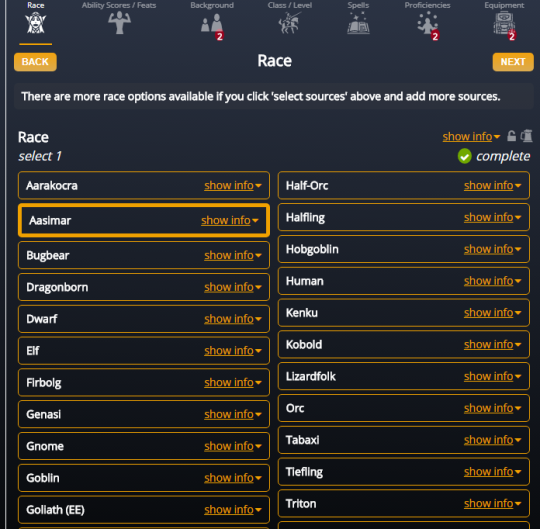
Have all you Dungeon and Dragon players heard of Orc Pub? It allows you to easily and freely create a DND character.
It informs you about each race, here you can see I’m remaking my Aasimar from a new game.
It can calculate all of your abilities for you if that’s something you have trouble with. I certainly have a hard time. Or if you’re super awesome and can do it by yourself there is a manual way to do it!
Basically it just helps you go step by step figure out what feats you might want, what alignment you might want, what comes items (weapons, armor, and gold etc) come with your character’s background and class.
Did I mention its FREE?
Right now there is a kickstarter to help make a mobile app, but right now I can easily transfer this info onto my character sheet!
For those who prefer the new edition.
:O
Sweet! I knew about this a while back, but its equipment database hadn’t been built out fully yet, so it was missing some stuff – Forgery Kit and Disguise Kit, if I recall correctly – that my character uses on a regular basis. And now that stuff is in there, so I’m good to go and will donate to the Kickstarter.
Meanwhile, D&D Beyond still only has like 6 Backgrounds in its database.
First of all, try not to. A lot of RPGs are meant to be a team effort and being a loner, while great for media with only one or two protagonists, is cancer to a group. Especially if everyone thinks they are the coolest person in the room.
DM: You are all gathered around the campfire when you hear a twig snap nearby! You think you hear the tell-tale yipping of bloodthirsty gnolls!
Man with No Name: I casually light up my pipe and brood on my log.
Edgelord: I continue to sharpen one of my many blades and brood.
Tough Goth: I brood near a tree, away from the campfire.
DM: Okay but is anyone gonna do anything other than brood? Like have normal human reactions to things or conversations about the possible ambush?
Druid Cast Out By Modern Society: I brood in a tree, two miles away.
Loners kill the mood of a campaign because everyone needs to be cool and unimpressed by the world around them. There’s a reason loners work alone. But what if you really want to play one or it fits your character’s story and personality? There are ways to play it successfully.
Character Arc
All characters need an arc; a way for their personality, flaws, traits, and ideals to change over time. This is especially true for loners. If you go into a campaign as an antisocial black sheep and go on a hundred dangerous quests risking lives for one another even the hardest loners will open up at some point. Maybe the party members fill a hole they never realized needed to be filled. Maybe caring about others or having others care about you will make you realize something you never knew about yourself.
Think about it: even the most stoic and antisocial characters in movies, stories, and video games are the most memorable when they break character; when their true self shines through. When the hardened war veteran is found crying in their room, or when the ice queen smiles for the first time, or when you find out the ill-tempered cop has a soft spot for kittens. These are the moments you remember and they will make you a more enjoyable loner to play with.
Stay Involved
Many people play loners as an excuse to zone out during the game. They use their brooding time to not get involved in combat, check their phones, chat with neighbors… this is all destructive to the game. “But my character doesn’t talk, like, ever!” That’s okay. You can still communicate and participate. Just because no one is telling you what to do and you aren’t telling anyone else what to do doesn’t mean you are a pile of wet towels. Communicate through nonverbal means to maintain your edginess but still participate. Make sure the other players know why you are doing it and what your are trying to communicate.
“Reaper McDeathman nods his head in agreement.” (They didn’t just nod their head, they also agree. The more info conveyed to the team, the better)
“Clint Scruffscar whistles to get your attention and points at the cave entrance he found.” (He conveys important plot info to the party while still being chill)
“Raven Roseskull motions for the rest of the group to follow her.” (She takes leadership of the group even though she’s presumably a brooding loner)
“Pale Vampireface pushes aside the city guard and strides toward the throne room. I roll to intimidate.” (She is interacting with an NPC she wishes to get past while maintaining a grimdark attitude)
Think about how your character carries themselves. What sorts of mannerisms do they have? Think about what you as a person want to convey to the party or to NPCs, then determine how your character would communicate that. Remember that in movies and video games, these visual cues from the loner characters are obvious. The camera zooms in on them or the composition focuses on them when they so much as twitch their eyes and trigger finger. The people at the table are not in your head. They can’t see any of that. It’s up to you to get the camera’s attention.
Be an Asset
The group needs to have a reason for you to be there. If they have none, they won’t have any reason to save you when you die or follow you through the pits of Hell. Your story isn’t the only one that matters. Be helpful when another person is trying to do something important to them. Don’t just be a stick in the mud and say “well why should I help you? What’s in it for me?” Try to find those reasons on your own. You can verbalize it to the table if it will help maintain your loner-ness. “Well, my character wouldn’t normally help you, but they feel like you might owe them something in the future.” This keeps you engaged and clues the party in on what they can do to motivate your character in the future.
If you have trouble thinking of one, try to have a reason to be in the party. Do you need them to complete your secret plans? Do you need to keep a low profile? Do you secretly want attention, glory, or wealth? Or maybe you have a heart of gold and actually care about your group.
Asides
One-on-one in-character chit-chat can develop your character and relationships with the players without harming your edgy ego. You don’t need to be a leader or public speaker, but a loner can have asides with other characters. It’s more dramatic, it adds tension, and it lets you have a mini-secret from the rest of the party (besides that one person you talked to). This way the players aren’t just travelling with some random mute who is sometimes useful but mostly just an edgy desk lamp.
Communicate Intent
Let other players know you are playing a loner ahead of time so they are aware that you might not always communicate directly. Furthermore, talk to other players out-of-character often. Just because your character is a brooding loner doesn’t mean you should be. Laugh, converse, have fun! If your character doesn’t say anything, let the other players know why so they don’t just leave you behind.
Promethean’s Cuprum writeup is helpful. Withdraw, but observe, react and intervene when doing so is important (IC)/interesting (OOC).




 Pidge's Blog backup
You must be logged in to post a comment.